

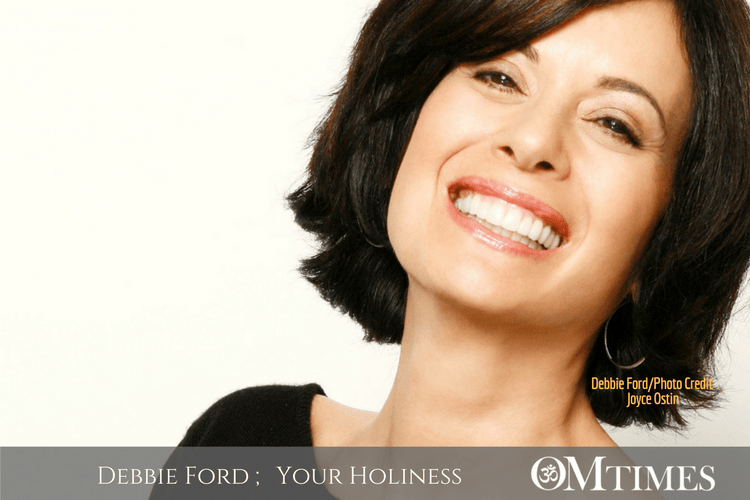
Debbie Ford: Your Holiness – An Interview with Arielle Ford

Arielle Ford: Zero, none. No, she was a party animal, and she liked to get dressed up and go to nightclubs. And as young as the age of 12, she was doing drugs and hanging out at nightclubs. So, she had a wild and crazy life.
Victor Fuhrman: You’ve said, if you had to describe Debbie Ford in one word, that word would be a seeker. What were the different stages of seeking, in her 20s, for example, 30s and 40s?
Arielle Ford: Well, the seeking part started after she got sober. So, she was a drug addict for about a dozen years. And when she was in her late 20s, she went to a variety of treatment centers, and the first three didn’t work at all. She’d get there for about 10 days, start to feel pretty good, realize that she didn’t think she needed any more treatment or that she should be hanging out with the losers in the treatment center, and she’d check herself out.
But, when she got to the fourth treatment center, and she got to day 10, she realized by that point that, if she didn’t stick it out, if she didn’t stay, she was gonna die. When she got to day 10, which was usually her day to bolt treatment centers, she locked herself in the bathroom of the center and got down on her hands and knees. In spite of the fact that the floor was filthy and stinky, and she was a clean freak, and just began to cry hysterically and to beg God for help to find a way to stick it out and get clean and sober so that she wouldn’t die young.
And while she was praying, she had an awakening. And for the first time, she began to feel a sense of peace and a sense of possibility, and she said even a little joy and excitement that she could make it through one more day. And that was really the beginning of her seeking. That was the start of her path to sobriety, which altered the course of her life.
Victor Fuhrman: What was her relationship with God before that moment?
Arielle Ford: I don’t really know. We never talked about it. We were raised Jewish in a conservative synagogue, so we went to Hebrew school, we got Bat mitzvahed, we went to high holy day services, which we tried to sneak out of as much as possible. Debbie Ford liked being Jewish. She liked the rituals. She didn’t mind it so much. I consider myself a gastronomic Jew. I’m only in it for the food. I describe myself as a Jewish Christian Hindu Buddhist Pagan, not necessarily in that order.
But, as Debbie got older and got more on her path, she really embraced Judaism, she became very close to a Chabad rabbi after she had her son and actually took him on a trip to Israel with her and 200 other people maybe nine months before she died.
Victor Fuhrman: So, she’s recovering from her drug addiction, what was next on her path?
Arielle Ford: Debbie had dropped out of high school. So, as she was really starting to explore what it would be like to be sane and emotionally healthy and healed from addiction. I was sharing information with her, Deepak tapes and Wayne Dyer tapes, literally those cassette tapes. And she decided to get her GED and then go to college, and she got a degree from JFK University in transpersonal psychology.
And I remember her telling me one day about three years into her sobriety that she now understood that the body was capable of fully healing from just about anything. People could have terminal cancer and then come back and go into total remission and their cells could be healed. Why couldn’t that also be true for addiction?
She was studying the work of Carl Jung, and she discovered what he had to say about the shadow, which she liked to call the dark side. She found it to be gifts and embraces all the negative emotions of anger, fear, guilt, shame, everything, and what could that possibly mean for her life. While she was simultaneously learning to embrace her good qualities, her light side, her loving, generous, compassionate nature.
This became the basis of what she was interested in for her own self-healing. And at that time, she was working, and her work was that she did witness prep. Trial consultants would hire her to spend time with their clients that needed to go on the witness stand and show up as believable and authentic. And Debbie Ford had a real knack for transforming them.
So, that was her day job. And at night, she was going to, school, and she was studying every kind of self-help thing known to man and really dedicated to healing her physically, emotionally, psychologically and spiritually.
Victor Fuhrman: Now, in her Dark Side of the Light Chasers, her groundbreaking first Best Seller, she wrote about that process of unmasking and embracing our shadow selves. How did she do that with her own shadow?
Arielle Ford: Well, the first shadow she embraced was when she was taking a leadership and speaking workshop, and the instructor said Debbie Ford got up and spoke, and then the instructor said to her, Debbie Ford, you know, you’re a real bitch.
Debbie was thinking to herself, well, I know that, but how does she know that. Debbie was really ashamed that this woman had called her out in front of the whole class and said she was a bitch.
Then the instructor said to her, well, can you see that there’s anything positive about being a bitch. Like, what is the benefit? Debbie thought about it, one of her other jobs was she liked to flip houses. She was great at remodeling houses. And she said, well, it’s really a benefit when the contractors aren’t doing the job that I can go in there and be a bitch and call them out and light a fire under them. That’s, you know, that’s a real benefit of being a bitch.
And the instructor said to her, yes, it is. So, you can find a way to find all the gifts of being a bitch and embrace that. When you’re speaking, we see the fierce part of you that’s so useful, but we don’t see sort of the nasty, angry bitch part of you that is what we see now. So, that was like step one on the path for her.

Victor Fuhrman: So, we’re talking a little bit about the shadow work that Debbie Ford did, she helped hundreds of thousands of people transform their pain into their best possible lives. Why do you think she was so masterful at what she did?
Arielle Ford: Oh, wow. She was just born to teach. She really saw what was possible in her own life, and she wanted to make sure that anybody else who wanted to be freed from the tyranny of their own critical mind, that she knew she could help them. She had the tools.
And she was not a kind or sweet teacher. She was rigorous. She didn’t put up with any BS. She would really get in your face and tell you what was so.
Victor Fuhrman: I had the pleasure only of meeting her once when she was teaching here in New York several years ago, and I was really impressed, not only with her ability to cut through the chase and get right to the heart of what happens inside of people but also her warmth. She was a very warm woman.
Arielle Ford: Yeah, she was warm, she was funny, she was friendly. But, when she was teaching, you don’t want to mess with her.
Victor Fuhrman: That’s beautiful. You and Debbie Ford used to have a website called Ford Sisters, and you were known as the Metaphysical Angels. What a wonderful title. Who led who on the path of enlightenment?
Arielle Ford: It was really a joint process because Debbie Ford was in her 12 step programs. She was already sober at least a year when I moved to LA, and I was already interested in a lot of this stuff, but we were taking different paths. But, we would often compare notes.
So, it was sort of a parallel track. She was in South Florida. I was in Los Angeles. Then we both moved to San Diego in 1994. Deepak Chopra was sort of the catalyst for all of that because Debbie Ford moved because she had gotten married, and her husband at the time, Dan, lived here in San Diego. I was working with Deepak, and he had just moved to San Diego to open the first Chopra Center. So, I was down here all the time until the point where I realized I should be living here, too.
Continue to Page 3 of the Arielle Ford interview of Debbie Ford


