


In Cosmic Memory, Rudolf Steiner does not invite readers to merely ponder the myths of Atlantis and Lemuria from a comfortable distance, but instead challenges them to recognize these lost civilizations as living chapters in their own spiritual history—awakening a memory not of the intellect, but of the soul itself.
Book Review – Cosmic Memory: Atlantis and Lemuria
Book by Rudolf Steiner

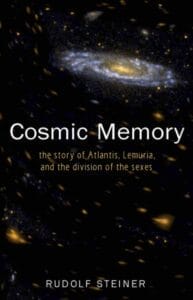
Rudolf Steiner’s Cosmic Memory: Atlantis and Lemuria is not a book for the casual reader. It is a door: one that opens into a vast spiritual history of humanity, stretching far beyond recorded civilization. First published in the early twentieth century, the work gathers essays Steiner wrote, Cosmic Memory, between 1904 and 1908, during a period when Europe was alive with occult revival, mystical societies, and bold new philosophies.
Anthroposophy is a path of knowledge to guide the Spiritual in the human being to the Spiritual in the universe.
~ Rudolf Steiner
In this unusual volume, Steiner presents a sweeping account of lost civilizations such as Atlantis and Lemuria, not as myths, but as chapters in humanity’s spiritual evolution.
His purpose with Cosmic Memory is not to entertain with legend, but to describe what he believed were insights drawn from clairvoyant perception and esoteric research. Whether one accepts his premise or not, the book’s ambition is undeniable.
The Heart of Cosmic Memory
The Cosmic Memory’s book begins with Lemuria, a vast ancient continent said to have existed before Atlantis. Steiner describes early humanity as dreamlike, possessing a different form of consciousness—less intellectual, more instinctive and spiritual. In his account, these early humans were guided by higher beings and gradually developed physical form and self-awareness.
Atlantis follows as the next stage. Steiner portrays it as a technologically advanced yet spiritually powerful civilization whose downfall came from moral corruption and the misuse of psychic forces. The Atlanteans, he suggests, possessed abilities that modern humanity has largely forgotten.
What stands out most is Steiner’s tone. He writes with calm certainty, almost scientific in rhythm, even as he describes extraordinary events. There is little drama in his language; instead, he builds his narrative carefully, layer by layer. For some readers, this steady pace may feel dense. For others, it creates a sense of gravity and seriousness.
Steiner’s larger aim is not to prove Atlantis existed in the physical sense. Rather, he frames these epochs as stages in humanity’s inner development. The evolution he describes in Cosmic Memory is spiritual before it is material. Human consciousness, in his view, is the true subject of history.
A Portrait of Rudolf Steiner
Rudolf Steiner (an Austrian philosopher, mystic, and founder of Anthroposophy, a spiritual philosophy that seeks to unite science, art, and religion). Educated in mathematics, science, and philosophy at the Vienna Institute of Technology, Steiner began his career editing the scientific writings of Goethe. Over time, his interests turned toward spiritual science and the hidden dimensions of human consciousness.
He founded the Anthroposophical Society in 1912 and later developed practical applications of his ideas in education (Waldorf schools), biodynamic agriculture, medicine, and architecture. The Goetheanum in Dornach, Switzerland—an architectural masterpiece he designed—remains a center for his movement.
Steiner was a prolific lecturer and writer, delivering over 6,000 lectures and publishing dozens of books. His influence continues to ripple through spiritual communities and alternative education systems worldwide.
Curious Facts About Steiner
He Claimed to Recall Spiritual Worlds from Childhood
Steiner said that from an early age, he could perceive spiritual beings and realities alongside the physical world. He treated these experiences as natural extensions of consciousness rather than fantasies.
The First Goetheanum Burned Down on New Year’s Eve
The original Goetheanum, built almost entirely of wood and considered a masterpiece of organic architecture, was destroyed by fire in 1922 under suspicious circumstances. Steiner later oversaw the design of a second, concrete structure that still stands today.
He Developed Biodynamic Farming
In 1924, Steiner delivered lectures that became the foundation of biodynamic agriculture, one of the earliest forms of organic farming. His ideas about cosmic rhythms and soil vitality are still practiced by farmers across the globe.

Cosmic Memory – Themes and Style
At its core, Cosmic Memory explores:
- The evolution of human consciousness
- The relationship between spirit and matter
- Karma and reincarnation
- The role of moral development in civilization
Steiner’s writing style reflects his background in philosophy. Sentences can be long and abstract. He expects the reader to think deeply and move slowly. This is not a novel but a meditation in prose form. There are moments where the language feels distant, yet beneath that formal tone lies genuine conviction.
Click HERE to Connect with your Daily Horoscope on OMTimes!
Visit Our Astrology Store for Personalized Reports

OMTimes is the premier Spiritually Conscious Magazine. Follow Us On Facebook, Twitter, Instagram, Linkedin, Pinterest, and Youtube


